Author: Charles Ogu

HPV (Human Papillomavirus) is incredibly common. It is spread primarily through sexual contact, and most people will be exposed at some point in their lives. In many cases, the body clears it naturally without any symptoms. But sometimes, high-risk HPV infections persist and that’s when cancers can develop. [1]
Here’s the part that should stop everyone in their tracks:
Almost all cervical cancer cases (about 99%) are linked to persistent infection with high-risk HPV. [2]
That’s not a “maybe.” That’s public health reality.
HPV isn’t the real threat the true danger lies in silence, misinformation, and the critical gap between what people need to know and what they actually learn.
HPV has become one of those topics people avoid until it becomes personal. Until a test result comes back. Until someone they love is diagnosed. Until “it” is no longer something that happens to “other people.”
So why does HPV still feel like a taboo topic?
Because society has mixed HPV education with morality.
People treat HPV like a character flaw instead of a viral infection.
And that’s the trap.
When you shame people, they don’t ask questions.
When people don’t ask questions, they don’t get screened.
When they don’t get screened, cancer wins quietly.
The truth that changes everything: HPV-related cancers are preventable
We need to say it louder:
HPV vaccination works and it saves lives
The HPV vaccine is proven to be safe and highly effective and has the potential to prevent more than 90% of cancers caused by HPV. [3]
And this matters beyond cervical cancer. HPV is also linked to cancers of the anus, penis, vulva, vagina, and parts of the throat (oropharyngeal cancer). [1][4]
So no, it’s not “a women’s issue.”
It’s a human health issue.
Nigeria’s biggest advantage right now: We have an opportunity window

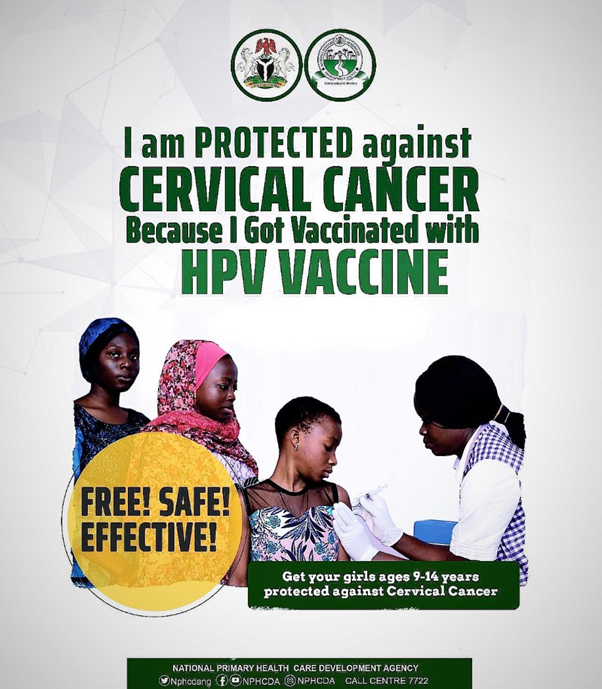
Nigeria introduced the HPV vaccine into its routine immunization program in October 2023, including a single-dose schedule, a major step forward for public health.[5]
This is powerful because it tackles one of the biggest barriers: access.
Simpler schedule → easier delivery → more girls protected → fewer future cancer cases.
In fact, a 2025 economic evaluation found that single-dose HPV vaccination is cost-effective in Nigeria, emphasising the importance of sustainable financing and health system strengthening to maintain impact. [6]
So yes! this isn’t just medically smart.
It’s economically smart.
But here’s the uncomfortable truth: A vaccine can’t protect people who don’t understand it
This is where the real enemy shows up.
Because misinformation moves faster than facts.
Some people still believe:
- the vaccine causes infertility
- the vaccine encourages promiscuity
- HPV only affects “bad people”
- screening is only necessary if you have symptoms
Let’s correct the record:
- The HPV vaccine does NOT cause infertility
Major public health bodies continue to state that the vaccine is safe and effective, with long-lasting protection. [3]
2. Vaccination is not permission; it’s protection
HPV vaccination is a cancer-prevention intervention, not a moral statement. WHO recommends vaccinating girls before age 15 as the most cost-effective strategy to prevent cervical cancer. [4]
- Waiting for symptoms is a dangerous strategy
Cervical cancer is preventable, but it requires early detection through screening, often beginning around age 30 (with earlier screening considerations for women living with HIV). [1]
If you wait until symptoms appear, you’re often arriving late to a fight that needed prevention.
Information is a vaccine too
At Ducit Blue Solutions, we believe prevention isn’t just clinical, it’s cultural.
We can’t reduce cancer burden with vaccines alone. We reduce it when:
- girls and parents understand why vaccination matters
- communities see vaccination as protection, not taboo
- men learn that HPV affects them too
- women see screening as self-respect, not fear
- policymakers fund programmes sustainably and publicly
Health literacy is protection.
And protection is power.
What we want you to do, starting today
If you’re reading this, you are now part of the solution.
Here are 5 actions that create impact fast:
- Talk about HPV openly in your circles, home, church, mosque, school, workplace.
- Encourage screening for women within recommended age groups especially those at higher risk. [1]
- Challenge misinformation immediately, don’t let lies settle into culture.
- Share this post! yes, this is your invitation to be “that person” who spreads facts.
Final word: Let’s stop blaming HPV and start fighting ignorance
HPV is a virus.
But misinformation is a system.
And systems can be changed.
If we want fewer funerals, fewer late diagnoses, and fewer “we didn’t know” moments, then we need to normalise education the way we normalise birthdays.
HPV isn’t the enemy. Lack of information is.
And at Ducit Blue Solutions, we’re choosing information because it saves lives.
References
- World Health Organization (WHO). Cervical cancer – Fact sheet. Updated 2 Dec 2025. (World Health Organization)
- World Health Organization (WHO). Cervical cancer – Health topic page (HPV causes ~99% of cervical cancer). (World Health Organization)
- U.S. Centers for Disease Control and Prevention (CDC). HPV Vaccination: HPV vaccine is safe and effective; can prevent >90% of HPV cancers. Updated 20 Aug 2024. (CDC)
- World Health Organization (WHO). Immunizing against HPV (Global Strategy guidance and vaccine value). (World Health Organization)
- Johns Hopkins Bloomberg School of Public Health (IVAC). One Dose at a Time: Mobilizing to Eliminate Cervical Cancer in Nigeria (Nigeria introduction October 2023). 30 Jan 2024. (publichealth.jhu.edu)
- Gao T, et al. Economic evaluation of the one-dose HPV vaccination program in Nigeria. (2025). (ScienceDirect)