Author: Emmanuel Oyelayo
Background
If you live in Africa, you probably know someone who has suffered from malaria. You might even have had it yourself. The disease is so common that many people have come to accept it as just another part of life. But the numbers tell a different story that demands urgent attention.
Globally in 2024, there were an estimated 282 million malaria cases and 610,000 deaths in 80 countries, according to the World Health Organization [1]. In 2024, the WHO African Region carries a disproportionately high share of the global malaria burden, as the Region was home to 95% of malaria cases (265 million) and 95% of malaria deaths (579,000) [1].
Behind these numbers lies another challenge that is less visible but equally important: the way malaria is diagnosed and treated can also intersect with the growing threat of antimicrobial resistance (AMR). Fever is not always caused by malaria, and where timely diagnostic testing is limited, people with suspected malaria may sometimes receive antimalarial medicines alongside antibiotics, either because of diagnostic uncertainty or as a precaution. Inappropriate antibiotic use contributes directly to antibiotic resistance, while inappropriate or unnecessary use of antimalarial medicines can contribute to the emergence and spread of drug-resistant malaria parasites [2].
Traditional malaria-control tools, including insecticide-treated mosquito nets, indoor residual spraying and manual identification of mosquito breeding sites, have saved millions of lives. Their effectiveness, however, is increasingly challenged by insecticide resistance, operational constraints, and environmental changes associated with climate change [3]. Locating and treating mosquito breeding sites across large and difficult-to-access areas can also require substantial human and financial resources, creating an opportunity for technology to make malaria prevention more targeted and efficient.
This is where innovation comes in. And one company is showing what is possible with technology and determination.
The Solution: SORA Technology (AI and Drones Working Together)
SORA Technology is a Japanese startup founded in 2020, headquartered in Nagoya [4]. Its mission is “Transforming lives from the sky” using drones, satellites, and artificial intelligence to tackle infectious diseases and support climate adaptation [4].
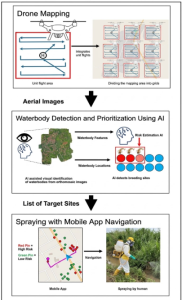
So how does it work? The company focuses on a strategy called Larval Source Management (LSM), targeting mosquito breeding sites before the larvae grow into adult mosquitoes that can spread disease [5]. But instead of sending workers to walk through swamps and wetlands searching for stagnant water (which is slow and expensive), SORA uses technology to do the job faster and more accurately [5].
Here is what happens:
- Drones fitted with cameras and sensors fly over large areas, capturing detailed images of the landscape [5].
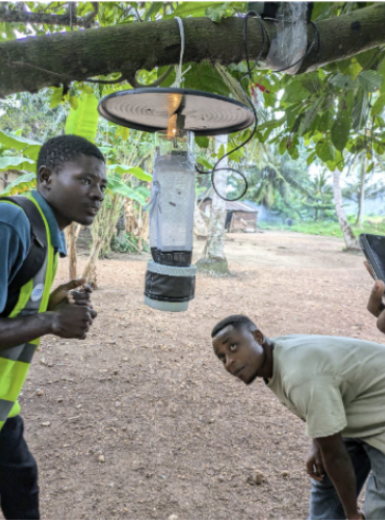
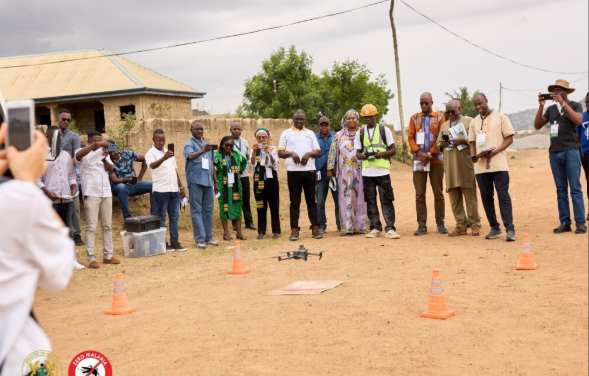
While traditional mosquito traps (left) help monitor vector populations, the addition of drone technology (right) allows field teams to rapidly scan and map stagnant water bodies across wide areas without labor-intensive manual searching. (Source: SORA Technology Website)
- Artificial intelligence analyses these images to detect water bodies and identify which ones are high-risk breeding sites for mosquitoes [5].
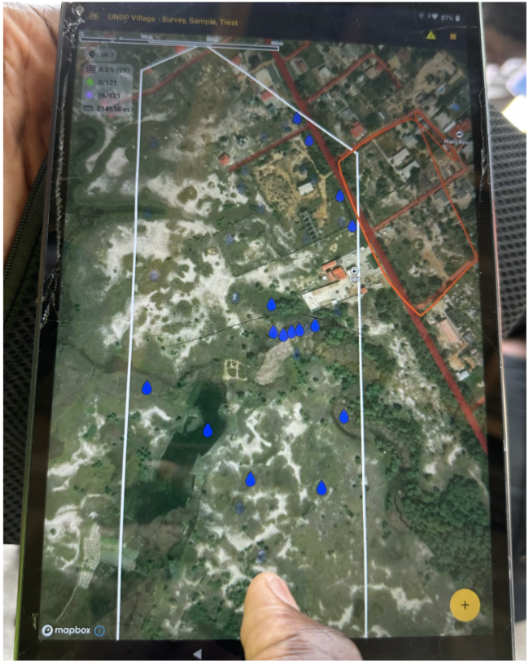
- Digital maps with exact GPS coordinates are generated, showing exactly where larvicide needs to be sprayed [4].
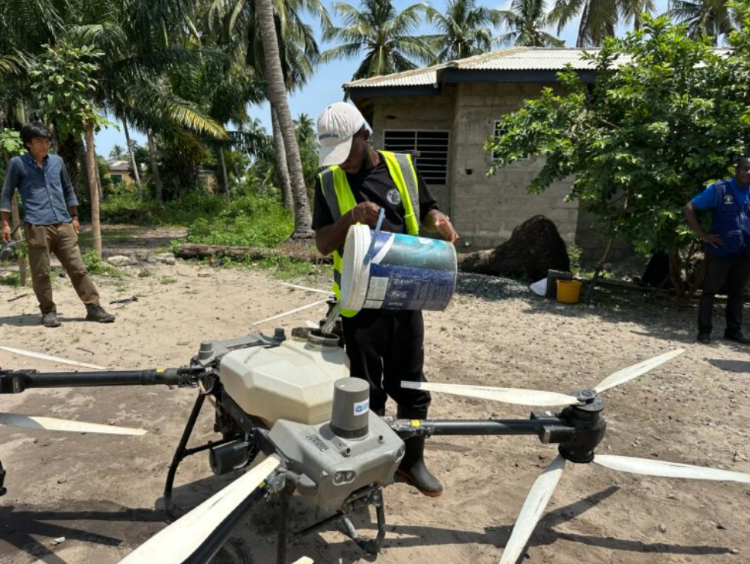
- Ground teams or sprayer drones then apply larvicide only to those pinpointed locations [5].
The results have been impressive. In Ghana, the company reported a decrease in pesticide use, savings on prevention costs, and decrease in labour costs [6]. According to NHK World Japan News Outlet, it was reported that Dr Paul Hilarius Asiwome Kosi Abiwu of Ghana’s National Malaria Elimination Programme explains: “When you know precisely where breeding sites are, you don’t go around with human resources looking for places to target. We are able to reduce the amount of larvicide use by 50 percent. This is a huge saving in terms of cost and efficiency” [5].
A pilot study conducted in the Kwaebibirem area of Ghana, published in the peer-reviewed journal PLOS One in February 2026, confirmed that the drone- and AI-enabled approach achieved malaria reduction and mosquito control effects comparable to those of conventional methods, while significantly reducing the human resources and larvicide volumes required [7]. The research was conducted in collaboration with the University of Ghana Business School and the Noguchi Memorial Institute for Medical Research [7].
Global Recognition and Partnerships
SORA Technology company has secured partnerships with some of the world’s most respected health organisations:
- Unitaid and the World Health Organization (WHO): In November 2025, SORA partnered with Unitaid and WHO to launch a pilot programme in Mozambique, one of the world’s highest malaria-burden countries [3].
- United Nations Development Programme (UNDP): In June 2026, UNDP launched a pilot study in Ghana’s Ada East district in partnership with SORA Technology, funded by the Government of Japan [4]. The project aims to generate evidence on how drones and AI can strengthen malaria elimination efforts.
- University of California, San Francisco (UCSF): In June 2026, SORA announced a collaboration with UCSF’s Malaria Elimination Initiative to help countries evaluate and scale technology-enabled mosquito control [8].
- Japan International Cooperation Agency (JICA): SORA’s early work in Ghana was supported by JICA, which helped validate the technology’s effectiveness [7].
SORA’s flagship SORA Malaria Control programme is now active in more than 10 African countries, including Ghana, Kenya, Sierra Leone, Benin, the Democratic Republic of the Congo, Senegal, Mozambique, and Uganda [9].
Relevance to Africa
Perhaps the most important question is what does all this mean for the average African?
- The most immediate and life-saving benefit is that fewer people (especially children under five) will contract malaria. This means more children growing up healthy and having a chance at a better life.
- By reducing the need for antimalarial and antibiotics, this technology helps slow the development of drug resistance. This means that when you or your child does get sick, the medicines prescribed will still work.
- When you don’t get sick, you don’t have to spend money on hospital visits or transport to health facilities. For families living on less than $2 a day, this is a significant financial relief.
- Malaria forces people to miss work and children to miss school. By reducing the number of cases, families can stay productive and children can stay in class
- Hospitals and clinics in malaria-endemic areas are often overwhelmed by malaria patients. Reducing the burden frees up beds and resources for other health needs
- The deployment of drones and AI requires local technicians and data analysts. This creates new employment opportunities and builds skills that can be applied across other sectors.
The Road Ahead: What Needs to Happen
SORA Technology has raised approximately $7.3 million in funding to scale its operations [9]. But technology alone is not enough. For this innovation to reach its full potential, several things need to happen:
- Governments need to create enabling policies for drone operations and invest in technology-enabled health solutions.
- International partners need to continue funding and supporting scalable innovations.
- Local capacity must be built by training local health workers, engineers, and data scientists to operate and maintain these systems [5].
At Ducit Blue Solutions (DBS), as we continue to explore bold ideas leading to emerging solutions and transformative innovations, we remain steadfast in our commitment to advancing patient safety and strengthening health systems that delivers high-quality healthcare services for all. Innovation goes beyond new technologies or approaches but about creating sustainable impact that improves outcomes and builds resilient systems that place people at the centre of care.
References
- World Health Organization. (2024). Malaria. WHO fact sheet. https://www.who.int/news-room/fact-sheets/detail/malaria
- Afolabi, O. T., Oluwatosin, O. A., & Adebayo, O. A. (2025). Antibiotic use and misuse in the treatment of malaria among university students in Nigeria. Discover Public Health, 22(1), 1–12. https://link.springer.com/article/10.1186/s12982-025-01047-x
- Unitaid. (2025, November). Unitaid partners with Japan’s SORA Technology and WHO to pilot AI-driven malaria prevention in Mozambique. https://unitaid.org/news-blog/unitaid-partners-with-japans-sora-technology-and-who-to-pilot-ai-driven-malaria-prevention-in-mozambique/
- SORA Technology. (2026, July 3). SORA Technology launches Ghana malaria elimination project through UNDP-led Access and Delivery Partnership and TDR. https://sora-technology.com/news_en/notice-260703/
- NHK WORLD-JAPAN. (2026). Japanese startup harnesses drones and AI to fight malaria. https://www3.nhk.or.jp/nhkworld/en/news/backstories/4962/
- EWN. (2026, February 25). Drones and AI-enabled tech lead fight against malaria in Ghana. https://www.ewn.co.za/2026/02/25/drones-and-ai-enabled-tech-lead-fight-against-malaria-in-ghana
- SORA Technology. (2026, February 5). SORA Technology’s research on drone and AI-driven malaria control published in PLOS One. https://sora-technology.com/news_en/sora-technologys-research-on-drone-and-ai-driven-malaria-control-published-in-plos-one/
- SORA Technology. (2026, June 17). SORA Technology and UCSF Malaria Elimination Initiative collaborate. https://sora-technology.com/news_en/notice-260515/#panel2-1 TechCabal. (2026,
- January 5). Japan’s SORA Technology secures fresh $2.5M to expand in Africa. https://techcabal.com/2026/01/05/japans-sora-technology-secures-fresh-2-5m/#1