When a child dies after a routine medical procedure, the tragedy reverberates far beyond a single family. It raises urgent questions about how healthcare is delivered, how systems protect patients they serve, and how far a health system must fail before it can claim to be truly safe and reliable.
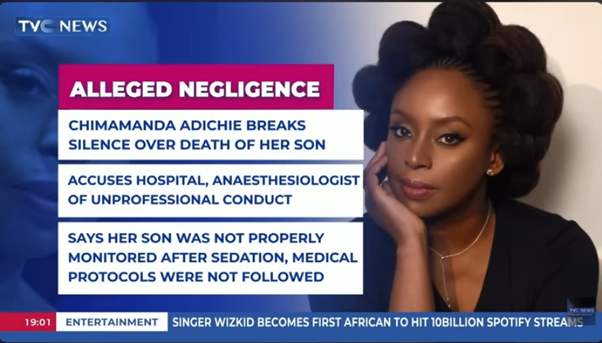
On January 6, 2026, internationally acclaimed author Chimamanda Ngozi Adichie publicly accused a private hospital in Lagos of medical negligence in the death of her 21-month-old son, Nkanu Nnamdi Adichie-Esege. According to her detailed legal notice and subsequent media reporting, her son was undergoing routine diagnostic procedures ahead of a planned medical evacuation to the United States when event turned tragically wrong. She alleged that the anesthesiologist administered an excessive dose of propofol, failed to continuously monitor the sedated child, and ignored standard safety protocols resulting in complications, seizures, cardiac arrest, and death2.
This heartbreaking story did not remain isolated; it sparked public outrage, widespread media coverage, and calls for a systematic overhaul of patient safety practices across healthcare institutions in Nigeria4. But more than a story about one hospital’s alleged failures, it has opened a wider conversation about a challenge that health systems across Africa and the world have long struggled to address: systemic negligence.
What Is Systemic Negligence and How is it Different from Medical Errors?
The term medical error traditionally refers to a failure in the delivery of healthcare services that may or may not cause harm – for example, administering the wrong medication dose, misjudging a clinical decision or misreading a test result. While serious, such incidents can sometimes be traced to a single individual acting in isolation.
Systemic negligence, on the other hand, reflects patterns of failure that are enabled by weaknesses in protocols, supervision, training, staffing, and organisational culture; not just one person’s mistake. Healthcare quality researchers and experts emphasised that many adverse outcomes are rooted in flawed systems rather than isolated events1.
This understanding aligns with the framework of the World Health Organization’s Global Patient Safety Action Plan 2021–20301, which recognises that preventable harm remains a serious challenge worldwide and calls for coordinated action to improve safety at the systemic level1. Until health systems are designed and governed to prevent harm structurally, individual errors will remain not exceptions, but predictable outcomes.
The Case That Sparked a National Reckoning
In the Adichie case, multiple reports corroborate her account that her son was sedated for imaging and invasive diagnostic procedures but was allegedly not continuously monitored thereafter – a critical breach of standard paediatric anaesthesia protocol. Ms Adichie subsequently described the conduct of the anaesthesiologist as “criminally negligent” and “fatally casual.” 3
In her legal notice, Ms. Adichie’s lawyers outlined concerns that, taken together, paint a picture extending well beyond individual misconduct:
- the cumulative dosing of sedatives in a critically ill child,
- lack of continuous physiological monitoring after sedation,
- inadequate airway management during and after the procedure,
- and failure to ensure the presence of sufficient medical support during patient transfers between units.2
The notice also demanded certified copies of all medical records and raised questions about informed consent and the availability of basic resuscitation equipment.2
These specific allegations cast the event not as an isolated clinical slip, but as evidence of systemic lapses in protocol adherence, patient monitoring, and clinical governance.
Taken individually, any one of these concerns might be attributed to human error. Taken together, they suggest something more troubling: a clinical environment in which multiple safeguards were either absent, poorly enforced, or routinely bypassed. This is the defining characteristic of systemin negligence not a single point of failure but the collapse of an entire layer of protective systems.
Systemic Risks in Healthcare: What the Evidence Shows
The Adichie case is devastating in its particulars, but it is not anomalous in its implications. Global patient safety research, including the foundational “To Err is Human report” from the Institute of Medicine, and WHO analyses, has long warned that unsafe care is a leading cause of preventable harm worldwide; often due to systemic weaknesses. Clinical errors are frequently the visible tip of deeper organisational issues such as:
- Inadequate staffing levels that stretch clinical teams beyond safe operating thresholds,
- Poor implementation of safety protocols,
- Deficient monitoring, escalation and handover systems,
- Weak accountability, audit and incident reporting frameworks
- Fragmented communication across clinical teams, particularly during patient transitions1
In resource-constrained settings like many African health systems, these challenges are amplified by infrastructure deficits, workforce shortages, and gaps in regulatory enforcement. These conditions can turn what should be standard procedures into life-threatening situations.
Nigeria’s Response and Calls for Reform
News reports confirm that the Adichie tragedy has prompted public discourse and demands for reform. Beyond widespread coverage, there have been calls from health professionals and civil society for stronger accountability, improved safety standards, and more robust clinical governance across both public and private healthcare facilities in Nigeria.5
Although health authorities have described plans to investigate (including in Lagos State) the event exposed structural issues that prevalence surveys and quality assessments have long identified in the country’s healthcare system. The Adichie case has brought these longstanding issues into sharper public focus and created a political pening for reform that advocates have long sought.
Moving Beyond Blame to Systemic Solutions
Accountability matters. When clinical negligence harms or kills a patient, those responsible must face apprpriate professional and legal consequences. But if disciplinary action is the only response to adverse outcomes, it treats symptoms while the underlying disease, the system itself continues unaddressed. Sustainable patient safety requires structural change.
Four evidence based strategies are widely recognised as foundational
- Building Strong Reporting and Learning Systems
Non-punitive error reporting allows organisations to learn from near-misses and adverse events, uncover trends, and redesign processes to prevent recurrence.
- Implementing Standardised Safety Protocols
Adherence to international safety standards, especially for sedation, anaesthesia, and patient monitoring must be mandatory, consistent, and audited regularly.
- Strengthening Workforce Capacity and Supervision
Adequate staffing, continuous training, and supportive supervision reduce burnout and improve adherence to safety protocols.
- Enhancing Regulatory and Accountability Frameworks
Robust oversight by medical boards, accreditation bodies, and safety agencies can ensure that safety standards are enforced and transparently evaluated.
These approaches align with WHO’s global patient safety Action Plan 2021-20301, which frames patient safety as an integral dimension of quality health services rather than an optional add-on.1
The question is not whether the solutions exist. It is whether the political will to implement them does.
Conclusion
The death of Nkanu Nnamdi; one of countless children whose lives are tragically cut short by preventable harm, is a stark reminder that unsafe care is not unavoidable. Medical errors often reflect underlying systemic weaknesses that can and should be addressed through deliberate policy action, stronger clinical governance, and a culture of safety that prioritises patients above all else.
No single event defines a health system. But every preventable death is a call to action, to build systems that safeguard life, ensure dignity, and uphold the fundamental promise of healthcare for all.
For Nigeria, and for many health systems across Africa facing similar structural vulnerabilities, the Adichie case presents both a moral imperative and a practical opportunity: to move from reactive blame to proactive reform, and to build healthcare environments where safety is not an aspiration, but a guaranteed condition of care.
References
- World Health Organization. Global Patient Safety Action Plan 2021–2030: Towards eliminating avoidable harm in health care. WHO; 2021. https://www.who.int/publications-detail-redirect/9789240032705
- Chimamanda Ngozi Adichie Issues Legal Notice to Lagos Hospital. TVC News. https://www.tvcnews.tv/chimamanda-adichie-issues-legal-notice-to-lagos-hospital-over-sons-death/
- Chimamanda Adichie’s account of sedation and procedural lapses. Pulse Nigeria. https://www.pulse.ng/story/chimamanda-adichie-accuses-euracare-hospital-of-negligence-over-death-of-son-2026011118195332630
- Chimamanda Ngozi Adichie accuses Lagos hospital of negligence. The Guardian. https://www.theguardian.com/books/2026/jan/12/chimamanda-ngozi-adichie-accuses-lagos-hospital-negligence-son-death
- Death of Chimamanda’s Son Prompts Calls for Healthcare Reform. The Guardian. https://www.theguardian.com/world/2026/jan/16/nigeria-call-overhaul-healthcare-sector-death-bestselling-author-toddler